Singing Plants
We should listen for the plant that has gone quiet.
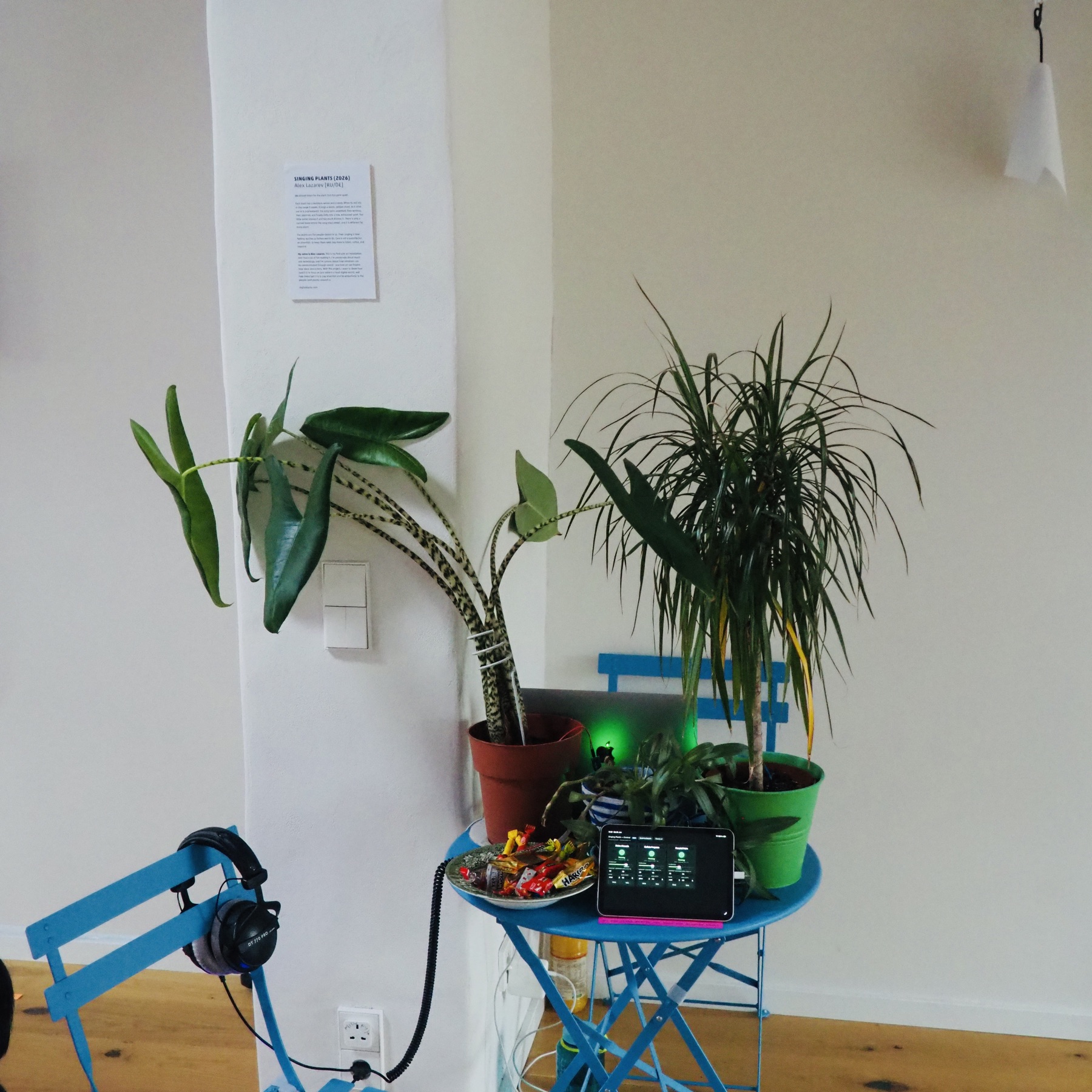
Each plant has a moisture sensor and a voice. When its soil sits in the range it needs, it sings a warm, settled chord. As it dries out, or is overwatered, the song turns unsettled, then anxious, then alarmed, and finally sinks into a low, exhausted near-silence. Too little water starves it, and too much drowns it. There is only a narrow band where the song stays sweet, and it is different for every plant.
The plants are the people closest to us. Their singing is how feeling reaches us before words do. Care is not a quantity but an attention: to keep them well, you have to listen, notice, and respond.
Where it started
I have a lot of different plants at home and there was always a problem with proper watering. So I decided that I should try to use technology to understand what is really going on and how plants react to my "care". I chose three potted plants, each with a moisture sensor pushed into the soil, so I could read how wet or dry each one was. Every species has its own comfortable range, a humidity corridor. The Zebra Alocasia likes its soil at 60-80%, the Ponytail Palm is happy much drier at 30-50%, and the Callisia Fragrans sits in a narrow 50-60% band.
While I was watching them, I felt: a plant can look completely fine, right up until the moment it is too late. By the time the leaves tell you, the damage is already done.
That felt familiar. People are the same. We can look perfectly all right on the outside while something is going on underneath, and often the only way to catch it is to actually talk: to hear the feeling, the small words, the tone, and from that sense how someone really is.
So I asked myself: is there a way to turn a plant's hidden signals into something we can feel? Music seemed perfect for it. Different chords carry different emotions almost instantly; we recognise them without thinking. So I built a small program that reads the moisture in each plant's soil and turns it into a chord that matches the plant's state.
How it works
Each plant is given a voice, a chord built on its own note, and an emotional range that follows its comfort corridor:
- In its comfortable range, it sings a warm major chord. Content.
- As it drifts out of range, too dry or too wet, the chord moves through stages: questioning, then anxious, then alarmed.
- At the far edge, it sinks into a low, exhausted near-silence, a plant with nothing left to give.
The voice does not only change chord; it trembles. As a plant grows more distressed, its singing wavers faster and wider, the way a voice shakes when someone is frightened or close to tears.
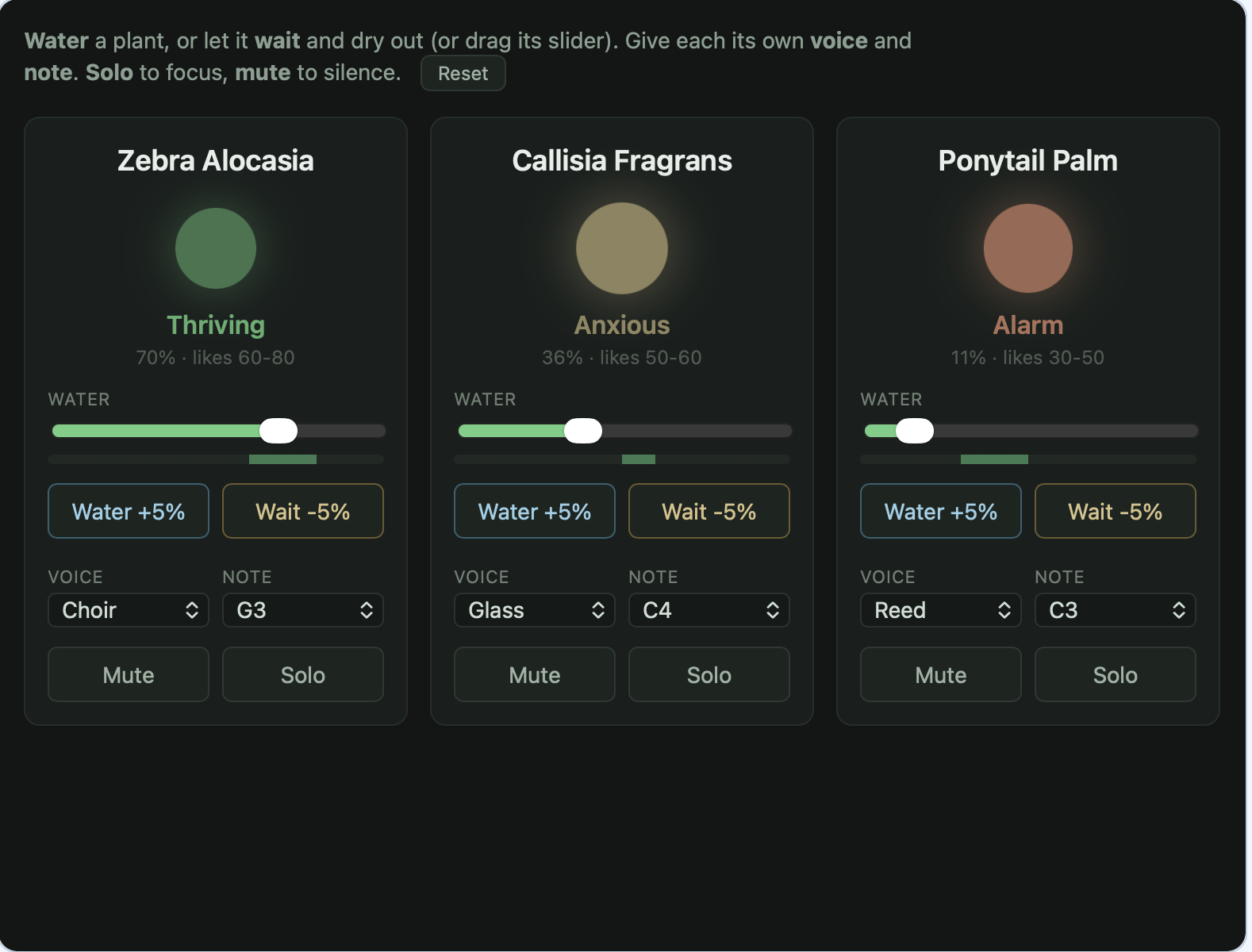
The whole thing runs from a laptop. The plants connect through an Arduino; the sound plays through headphones, an intimate, one-listener-at-a-time station; and everything is controlled from an iPad. There are two modes:
- Sensors mode: the real plants drive their own voices from the live moisture in their soil.
- Manual mode: I set each plant's hydration by hand, to play the full emotional range on demand.
What you hear
I usually start in manual mode, with all three plants well-watered. They are happy, so they sing together in a major chord, a calm and consonant wash.
Then I solo one plant, so we can focus on it alone. Imagine this one does not get watered for a few days. As its soil dries, it moves through the stages: questioning, anxious, alarmed, and finally it falls quiet, because it has no energy left to call out.
The same thing happens with people. First we try to express ourselves. But if no one responds, eventually we go quiet.
And here is the part that matters most: when I un-solo that plant and let all three play together again, you can no longer tell that anything is wrong with the quiet one. Its near-silence is buried under the voices of the plants that still have energy. You have to already be paying attention to notice who has gone quiet.
That is the heart of the piece. In a loud room, a loud world, the ones in trouble are often the hardest to hear. We have to listen for them.
You can try this yourself: play Singing Plants in your browser.
Drag a plant's water down until it falls quiet, then solo and un-solo it and see if you can still find it. Headphones help.
What it isn't
Moisture is only one of the things a plant needs. There is also light, air, the quality of the water, fertiliser, where it sits in a room. This installation listens to just that one signal, the same way a person is not happy or unhappy for a single reason like hunger.
Where it goes next
I want to keep developing it, to listen to more of what a plant needs, not only water. And I would like to live with it: to put it on my own plants at home, give them their own voices, and actually hear them sing.
About
My name is Alex Lazarev. This is my first solo art installation, and I had a lot of fun making it. I am drawn to music and technology, and I am curious about how emotions can travel through sound, and how art can spark new ideas and actions. With this project I wanted to show how hard it is to focus on a single voice in a loud digital world, and how much it matters to pay attention to the people (and plants) around us.
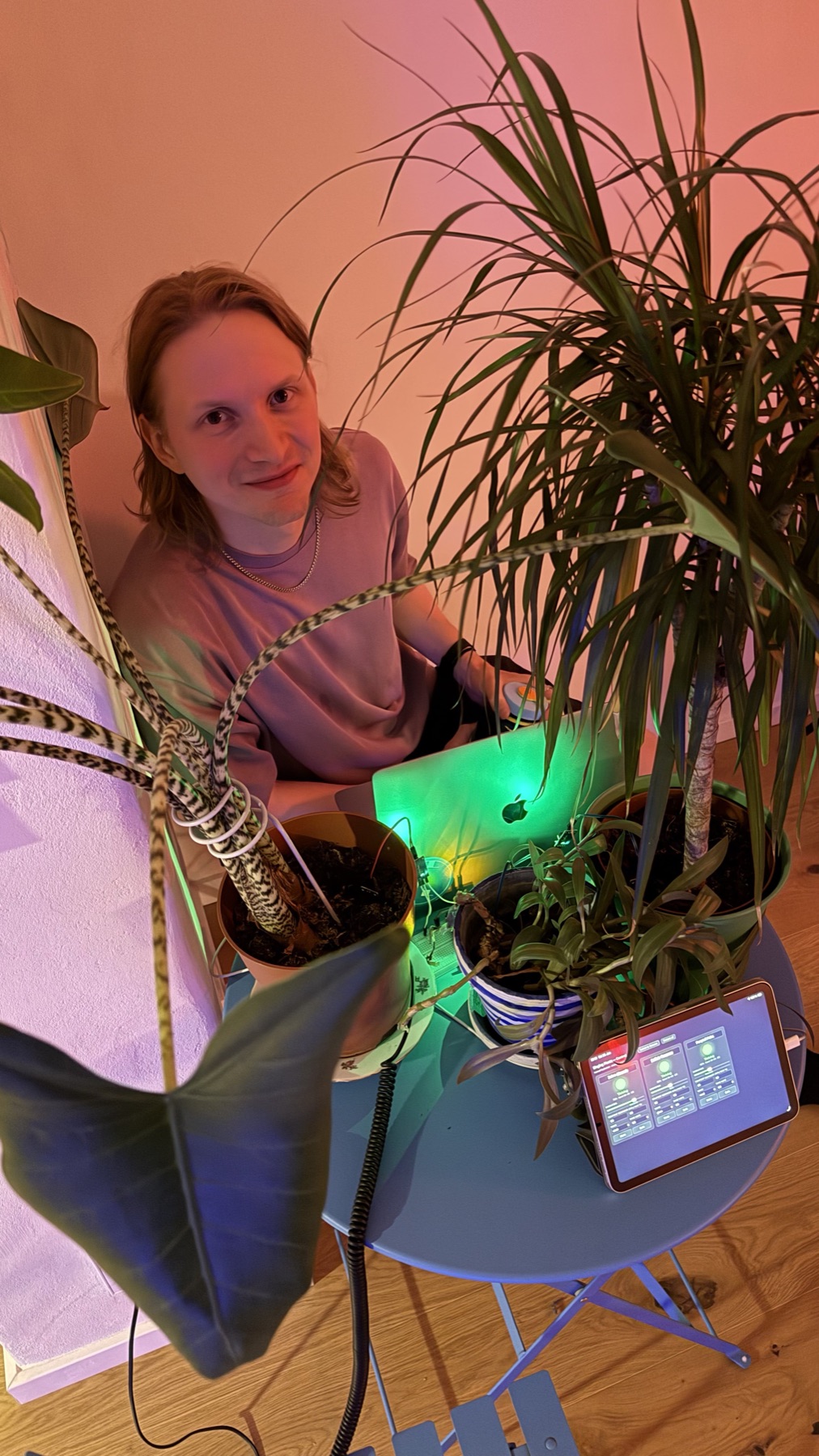
Singing Plants was shown at ACUD, Berlin, on 20 June 2026, as part of ACUD's 35th anniversary celebration. The project also grew out of the "After Hours" programme at School of Machines. Built with moisture sensors, an Arduino, and a small Python program; sound by additive synthesis, controlled from a browser. Special thanks to Rachel Uwa and Sarah Grant.
The code behind it will be shared here soon.